🛕 Neak Pean
នាគពាន់
Also known as: Coiled Serpents
Province
Siem Reap
Era
Late Angkorian
Difficulty
🟢 Easy
Crowds
😌 Low Crowds
Key Facts
Built: Late 12th century
Built by: King Jayavarman VII
Religion: Buddhist
Entry Fee: Angkor Pass
Time Needed: 20–30 minutes
UNESCO: ✅ World Heritage Site
A unique island temple set in an artificial lake, representing the mythical Lake Anavatapta — a healing sanctuary.
Neak Pean is one of the most unusual temples in the Angkor complex — a small Buddhist sanctuary built on a circular island in the center of the now mostly dry Jayatataka baray (reservoir). The temple represents the mythical Himalayan lake Anavatapta, believed to cure all illness. Four smaller pools surround the central pool, connected by gargoyle-like stone spouts depicting a human head, horse head, elephant head, and lion head. Pilgrims would visit to bathe in the healing waters, with the water flowing through different animal heads believed to cure different ailments. The central island features two intertwined naga serpents (giving the temple its name) and a remarkable sculpture of the flying horse Balaha rescuing shipwrecked merchants.
Background
Neak Pean is an artificial island with a Mahayana Buddhist temple on a circular island in the Jayatataka Baray, which was associated with Preah Khan and built during the reign of King Jayavarman VII. It is the "Mebon" of the Preah Khan baray. The name comes from the sculptures of snakes (nagas) running around the base of the temple, and some historians believe it represents Anavatapta, a mythical Himalayan lake whose waters were thought to cure all illness. It was designed for medical purposes and is one of the hospitals Jayavarman VII built: four connected pools represent Water, Earth, Fire and Wind. The only remaining statue is the horse Balaha, a form of the bodhisattva Avalokitesvara, and the temple on the lake was originally dedicated to Avalokitesvara.
Adapted from the Wikipedia article “Neak Pean” (revision 1379744455, retrieved 19 October 2026), licensed under CC BY-SA 4.0; text condensed and edited.
Print references cited by the Wikipedia article:
- Higham, C., 2014, Early Mainland Southeast Asia, Bangkok: River Books Co., Ltd., ISBN 9786167339443
- Coedès, George (1968). Walter F. Vella (ed.). The Indianized States of Southeast Asia. Trans. Susan Brown Cowing. University of Hawaii Press. ISBN 978-0-8248-0368-1
Highlights
- ✦ Unique island temple design
- ✦ Flying horse Balaha sculpture
- ✦ Four connected healing pools
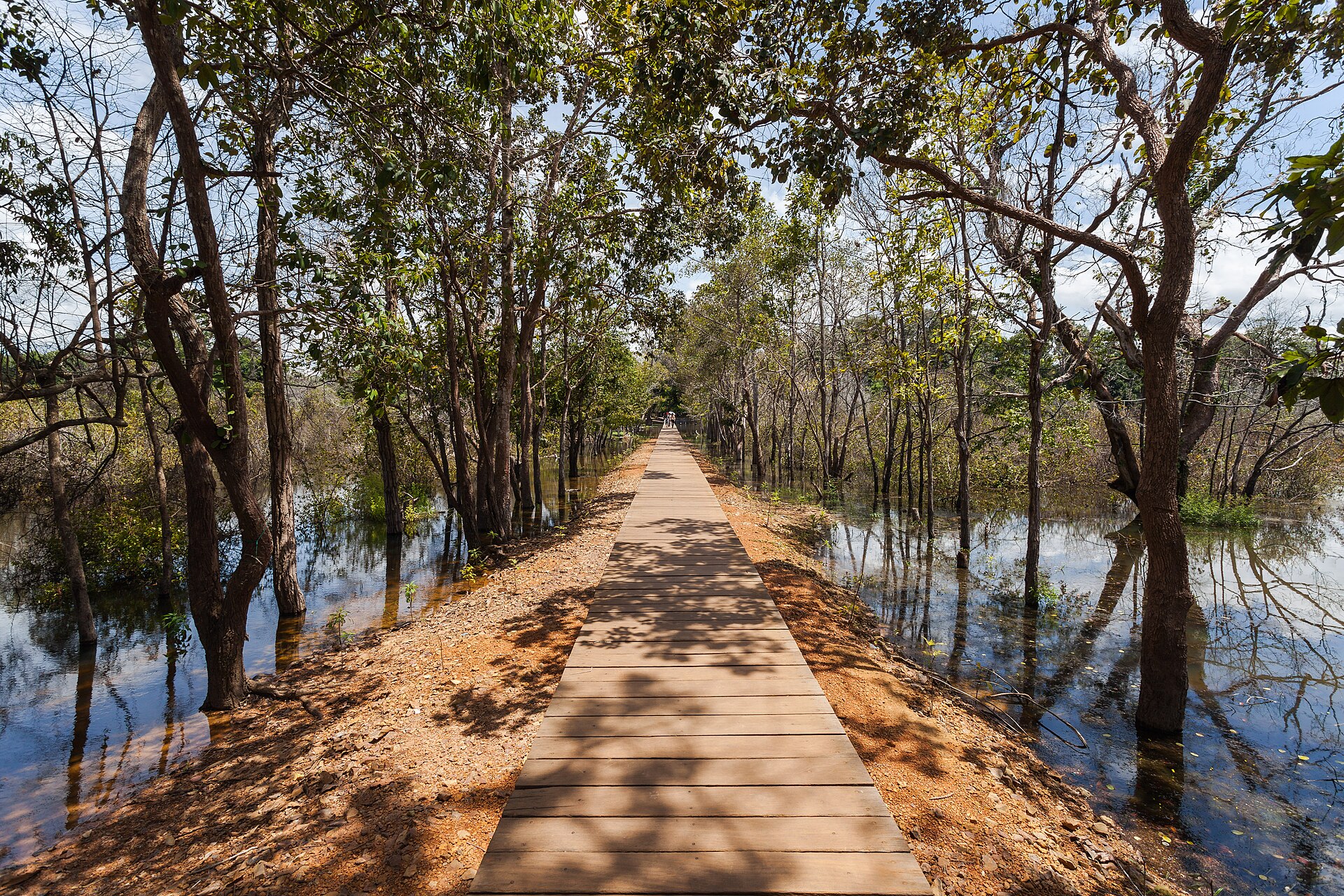
- ✦ Wooden boardwalk approach through forest
- ✦ Reflections in the water
Best Time to Visit
Rainy season (June-Nov) when pools have water
Visitor Tips
- 💡 Best visited during or after rainy season when water levels are high
- 💡 The 500m wooden boardwalk through the forest is pleasant
- 💡 Quick stop — combine with Preah Khan and Ta Som
Nearby Temples
13.4672°N, 103.8900°E
Get Cambodia Travel Updates
Visa changes, travel tips, and destination guides delivered to your inbox.
No spam, unsubscribe anytime. We respect your privacy.