🛕 Preah Khan
ព្រះខ័ន
Also known as: Royal Sword
Province
Siem Reap
Era
Late Angkorian
Difficulty
🟡 Moderate
Crowds
👥 Moderate
Key Facts
Built: 1191
Built by: King Jayavarman VII
Religion: Buddhist
Entry Fee: Angkor Pass
Time Needed: 1.5–2 hours
UNESCO: ✅ World Heritage Site
A vast monastic complex dedicated to Jayavarman VII's father — once home to over 100,000 officials and servants.
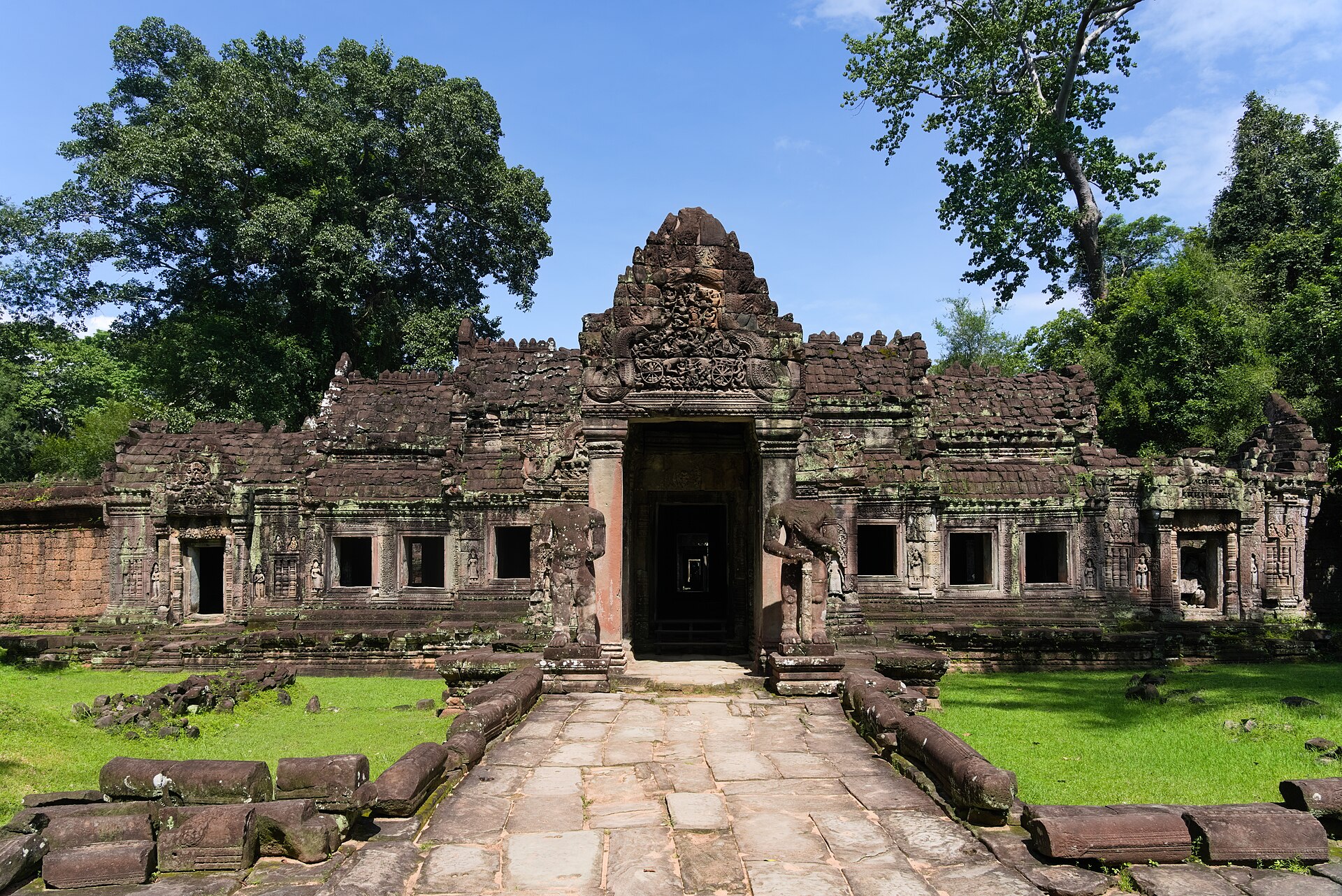
Preah Khan ("Royal Sword") was built by Jayavarman VII to honor his father, Dharanindravarman II. This massive complex served as a monastery, school, and city — the inscription reveals that 97,840 attendants and servants, including 1,000 dancers, once served the temple. The complex covers 56 hectares and features a remarkable two-story structure that is unique in Angkor architecture, possibly used as a library or storeroom. Long, atmospheric corridors create dramatic light-and-shadow effects, and the eastern entrance features an impressive Hall of Dancers. Unlike the more manicured Ta Prohm, Preah Khan retains a wilder, more adventurous feeling with fewer crowds, making it a favorite among repeat visitors to Angkor.
Background
Preah Khan, meaning "Royal Sword", is a Buddhist temple at Angkor, built in the 12th century for King Jayavarman VII to honour his father. The main image, the bodhisattva Avalokiteśvara in the form of the king's father, was dedicated in 1191. The institution combined the roles of city, temple and Buddhist university, with 97,840 attendants and servants, including 1000 dancers. The temple is flat in design, with successive rectangular galleries around a Buddhist sanctuary, complicated by Hindu satellite temples and later additions. Like the nearby Ta Prohm, it has been left largely unrestored, with numerous trees and other vegetation growing among the ruins.
Adapted from the Wikipedia article “Preah Khan” (revision 1367128849, retrieved 19 October 2026), licensed under CC BY-SA 4.0; text condensed and edited.
Print references cited by the Wikipedia article:
- Glaize, Maurice, The Monuments of the Angkor Group, p. 173 quoting Coedès (note 1 in the article)
- Higham, The Civilization of Angkor, pp. 128-129 (notes 3-4 in the article)
Highlights
- ✦ Two-story pillared structure (unique in Angkor)
- ✦ Hall of Dancers with apsara carvings
- ✦ Dramatic corridor perspectives
- ✦ Tree root formations
- ✦ Garuda wall decorations
- ✦ Much quieter than Ta Prohm
Best Time to Visit
Morning or late afternoon
Visitor Tips
- 💡 Enter from the east for the most impressive approach
- 💡 The two-story building is near the center — don't miss it
- 💡 Combine with Neak Pean and Ta Som on the Grand Circuit
Nearby Temples
13.4618°N, 103.8708°E
Get Cambodia Travel Updates
Visa changes, travel tips, and destination guides delivered to your inbox.
No spam, unsubscribe anytime. We respect your privacy.