🛕 Pre Rup
ប្រែរូប
Also known as: Turn the Body
Province
Siem Reap
Era
Classical Angkorian
Difficulty
🟡 Moderate
Crowds
👥 Moderate
Key Facts
Built: 10th century (961 AD)
Built by: King Rajendravarman II
Religion: Hindu
Entry Fee: Angkor Pass
Time Needed: 45 min–1 hour
UNESCO: ✅ World Heritage Site
A dramatic brick-and-laterite temple mountain — one of the best sunset viewpoints in the Angkor Archaeological Park.
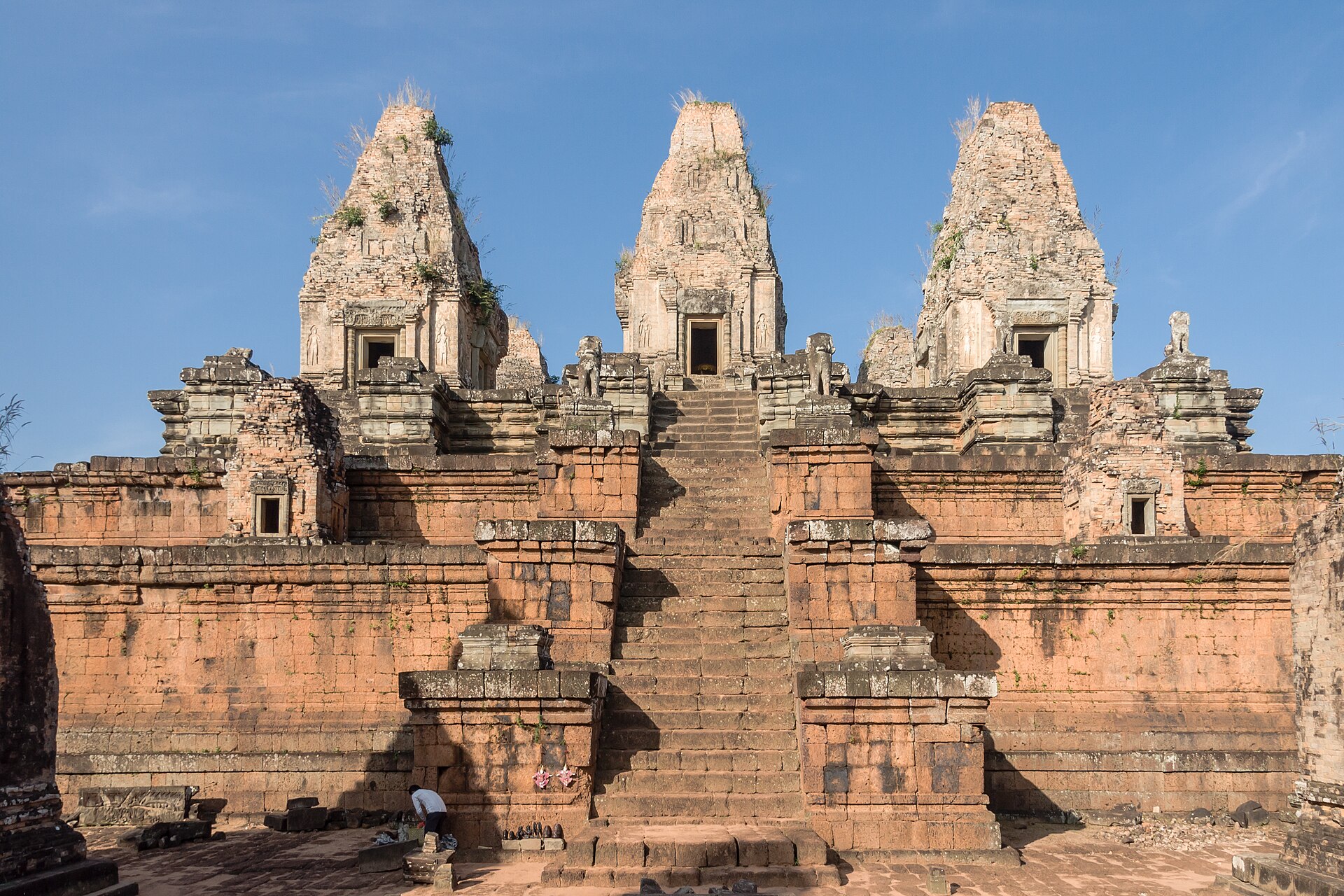
Pre Rup (meaning "Turn the Body") is a Hindu temple mountain built by King Rajendravarman II as the state temple of his capital. The name derives from the common belief that the temple was used for cremation rituals, where the body would be ritually "turned" in the ashes. The temple consists of a three-tiered pyramid with five brick towers on the summit platform, offering commanding views of the surrounding jungle and rice paddies. As one of the last major temples built with brick (rather than sandstone), Pre Rup marks a transitional period in Khmer architecture. The warm colors of the laterite and brick glow magnificently during sunset, making it one of the most popular sunset spots in Angkor.
Background
Pre Rup is a Hindu temple at Angkor, built as the state temple of the Khmer king Rajendravarman and dedicated in 961 or early 962. It was dedicated to the god Shiva and is a temple mountain of combined brick, laterite and sandstone construction. Located just south of the East Baray, it is aligned on a north-south axis with the East Mebon, also a creation of Rajendravarman's reign. Its extensive laterite and brick give it a reddish tone that is heightened by early morning and late afternoon sunlight. The final pyramid rises in three steep tiers to a square summit platform where five towers are arranged in a quincunx, one at each corner and one in the centre. The temple's name, meaning "turn the body", reflects the common belief among Cambodians that funerals were conducted there.
Adapted from the Wikipedia article “Pre Rup” (revision 1367128846, retrieved 19 October 2026), licensed under CC BY-SA 4.0; text condensed and edited.
Print references cited by the Wikipedia article:
- Coedès, George (1968). Walter F. Vella (ed.). The Indianized States of Southeast Asia. Trans. Susan Brown Cowing. University of Hawaii Press. ISBN 978-0-8248-0368-1
- Freeman, Michael; Jacques, Claude (2006). Ancient Angkor. River Books. ISBN 974-8225-27-5, pp. 158-160
Highlights
- ✦ Premier sunset viewpoint
- ✦ Five brick towers on summit
- ✦ Panoramic jungle views
- ✦ Beautiful brick and laterite coloring
- ✦ Sacred cistern at the base
Best Time to Visit
Late afternoon for sunset (arrive by 4:30 PM)
Visitor Tips
- 💡 Arrive early for a good sunset viewing spot on the upper level
- 💡 The steep stairs require some fitness
- 💡 Combine with East Mebon nearby
Nearby Temples
13.4500°N, 103.8996°E
Get Cambodia Travel Updates
Visa changes, travel tips, and destination guides delivered to your inbox.
No spam, unsubscribe anytime. We respect your privacy.