🛕 Baphuon
បាពួន
Province
Siem Reap
Era
Classical Angkorian
Difficulty
🟡 Moderate
Crowds
👥 Moderate
Key Facts
Built: Mid-11th century
Built by: King Suryavarman I (as his state temple)
Religion: Hindu
Entry Fee: Angkor Pass
Time Needed: 45 min–1 hour
UNESCO: ✅ World Heritage Site
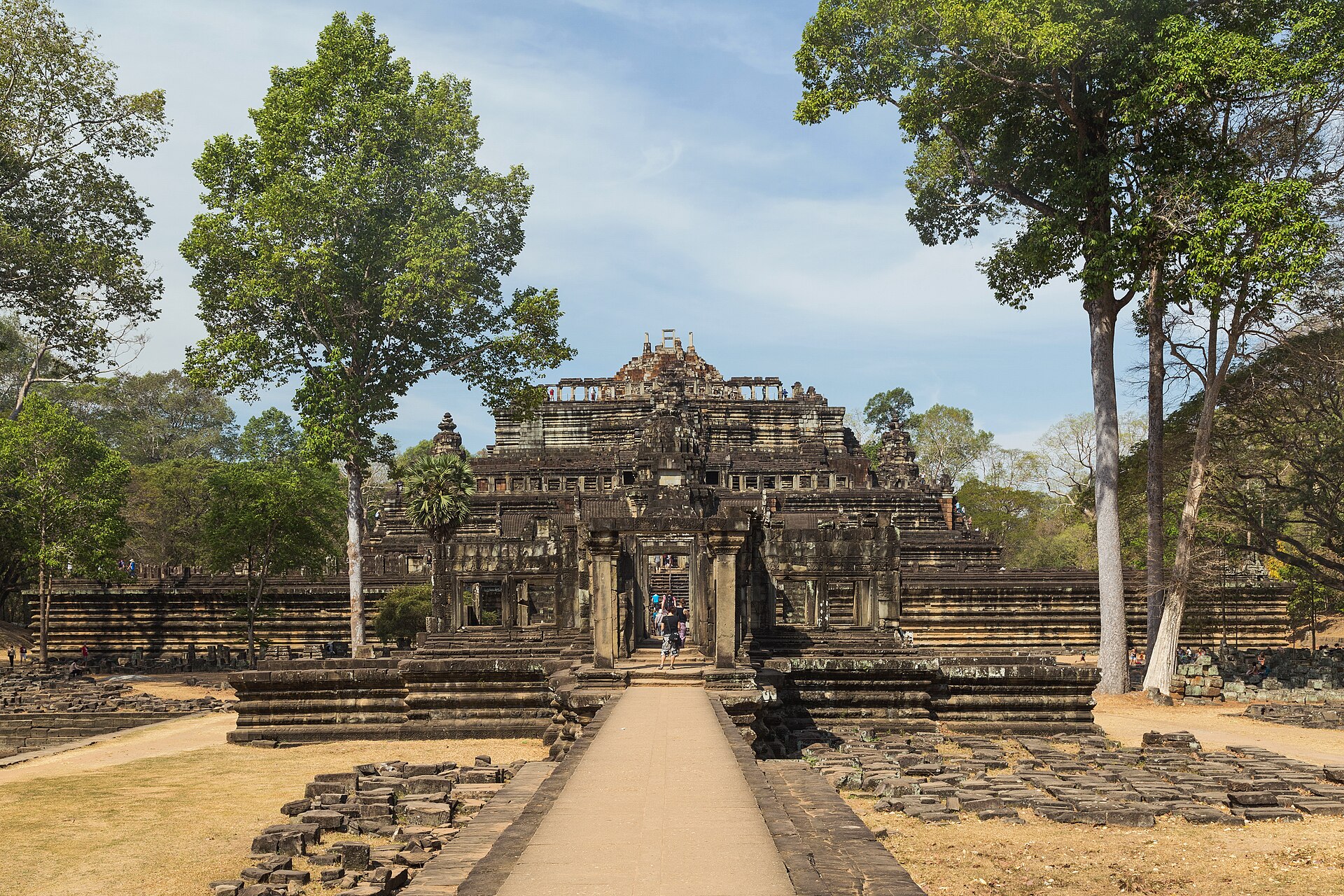
A massive three-tiered temple mountain with a stunning 200-meter elevated causeway and the world's largest reclining Buddha puzzle.
The Baphuon is one of the most impressive and historically significant temples within Angkor Thom. Originally dedicated to Shiva, it was built as a representation of Mount Meru. A remarkable 200-meter-long elevated sandstone walkway on round pillars leads to the temple entrance. In the 15th or 16th century, the west wall was rearranged to form a massive 70-meter-long reclining Buddha — one of the largest in the world. The temple underwent one of the most complex archaeological restoration projects in history, led by the French EFEO. Dubbed "the world's largest 3D jigsaw puzzle," the restoration took 51 years (1960-2011), surviving the Khmer Rouge era during which the original cataloguing records were destroyed.
Background
The Baphuon is a temple at Angkor, in Angkor Thom northwest of the Bayon, also called the "golden mountain" and built on an artificial hill. Built in the mid-11th century as a three-tiered temple mountain, it was the state temple of Suryavarman I, dedicated to the Hindu god Shiva, and is the archetype of the Baphuon style, with intricate carvings covering every available surface. A 2015 radiocarbon dating study of iron crampons showed it was not built under Udayādityavarman II, as popularly reported. It was later converted into a Theravada Buddhist temple, and a 9-metre-tall, 70-metre-long reclining Buddha was built on the west side's second level. After a restoration abandoned in 1970 and relaunched in 1996, the temple was formally reopened in 2011.
Adapted from the Wikipedia article “Baphuon” (revision 1376615481, retrieved 19 October 2026), licensed under CC BY-SA 4.0; text condensed and edited.
Print references cited by the Wikipedia article:
- Coedès, George (1968). Walter F. Vella (ed.). The Indianized States of Southeast Asia. Trans. Susan Brown Cowing. University of Hawaii Press. ISBN 978-0-8248-0368-1
Highlights
- ✦ 200-meter elevated causeway
- ✦ 70-meter reclining Buddha on west wall
- ✦ Panoramic views from upper levels
- ✦ Bas-reliefs of hunting and battle scenes
- ✦ 51-year restoration story
Best Time to Visit
Midday when crowds thin (combine with Angkor Thom visit)
Visitor Tips
- 💡 Walk around to the west side to see the reclining Buddha outline
- 💡 The elevated causeway is a great photo opportunity
- 💡 Accessible from within the Angkor Thom complex
Nearby Temples
13.4441°N, 103.8589°E
Get Cambodia Travel Updates
Visa changes, travel tips, and destination guides delivered to your inbox.
No spam, unsubscribe anytime. We respect your privacy.