🛕 Bayon
បាយ័ន
Province
Siem Reap
Era
Late Angkorian
Difficulty
🟡 Moderate
Crowds
🏟️ Very High
Key Facts
Built: Late 12th–early 13th century
Built by: King Jayavarman VII
Religion: Buddhist
Entry Fee: Angkor Pass
Time Needed: 1.5–2.5 hours
UNESCO: ✅ World Heritage Site
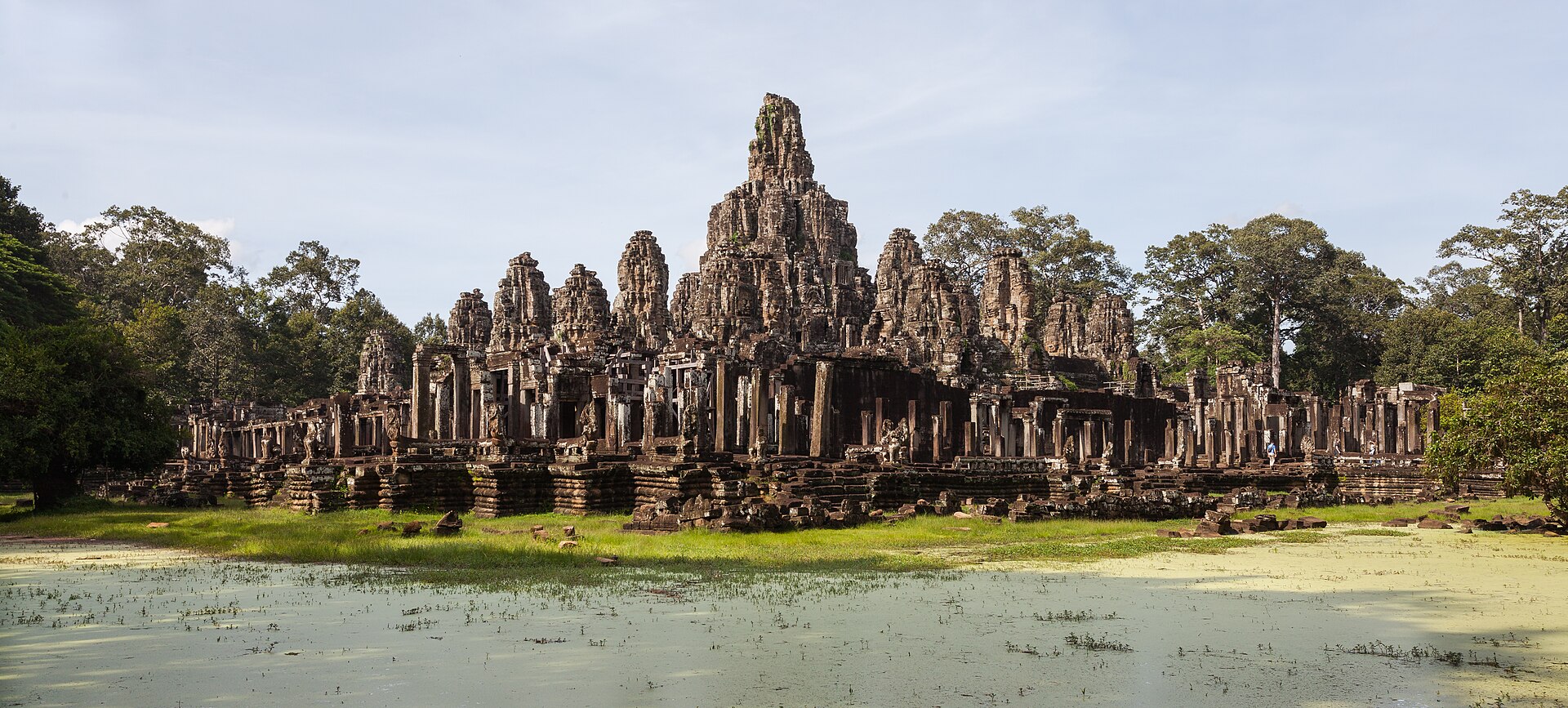
The enigmatic state temple with 216 serene stone faces gazing in all four directions from 54 gothic towers.
The Bayon is arguably the most visually striking and mysterious temple in the Angkor complex. Built around the turn of the 13th century as the state temple of Jayavarman VII, Cambodia's great Buddhist king, it sits at the exact centre of his walled capital, Angkor Thom. It was the last of the great state temples built at Angkor and the only one conceived primarily as a Mahayana Buddhist shrine.
The temple's defining feature is its forest of massive stone faces — more than 200 of them, gazing serenely from some 49 towers (plus the central mass). Their calm, faintly smiling expression is usually interpreted as the bodhisattva Avalokiteshvara, the embodiment of compassion, though many scholars see the features of Jayavarman VII himself, blurring the line between king and deity.
The outer gallery holds roughly 1.2 kilometres of bas-reliefs that are unusually devoted to ordinary life and history rather than pure mythology: bustling markets, cockfights, fishing, cooking and childbirth, alongside vivid land and naval battles against the Cham — including scenes of the great fight on the Tonlé Sap. This rare documentary record of 12th-century Khmer society makes the Bayon invaluable to historians. Later Hindu and Buddhist rulers altered and re-consecrated parts of the temple, adding to its layered, labyrinthine feel.
The compact, three-dimensional layout and narrow corridors create an almost dreamlike atmosphere. Mid-morning light, when the sun rakes across the towers, is the best time to photograph the faces; the Bayon pairs naturally with the nearby Baphuon, Terrace of the Elephants and the rest of Angkor Thom.
Highlights
- ✦ 216 giant stone faces
- ✦ Bas-reliefs of daily Khmer life
- ✦ Apsara dancer carvings
- ✦ Face-to-face photo opportunities
- ✦ Sunrise light on the faces
- ✦ Naval battle bas-reliefs
Best Time to Visit
Early morning (6:30-8 AM) for best light on the stone faces
Visitor Tips
- 💡 The upper terrace offers the best face-to-face encounters
- 💡 Southern gallery bas-reliefs show Cham naval battles on Tonlé Sap
- 💡 Visit before or after the main Angkor Wat crowd surge (7-10 AM)
Nearby Temples
13.4412°N, 103.8589°E
Get Cambodia Travel Updates
Visa changes, travel tips, and destination guides delivered to your inbox.
No spam, unsubscribe anytime. We respect your privacy.