🛕 Banteay Srei
បន្ទាយស្រី
Also known as: Citadel of Women, Citadel of Beauty
Province
Siem Reap
Era
Classical Angkorian
Difficulty
🟢 Easy
Crowds
👥 Moderate
Key Facts
Built: 10th century (967 AD)
Built by: Yajnavaraha (a Brahmin counselor)
Religion: Hindu
Entry Fee: Angkor Pass
Time Needed: 1–1.5 hours
UNESCO: ✅ World Heritage Site
A jewel of pink sandstone with the finest, most intricate carvings in all of Angkor — often called the "jewel of Khmer art."
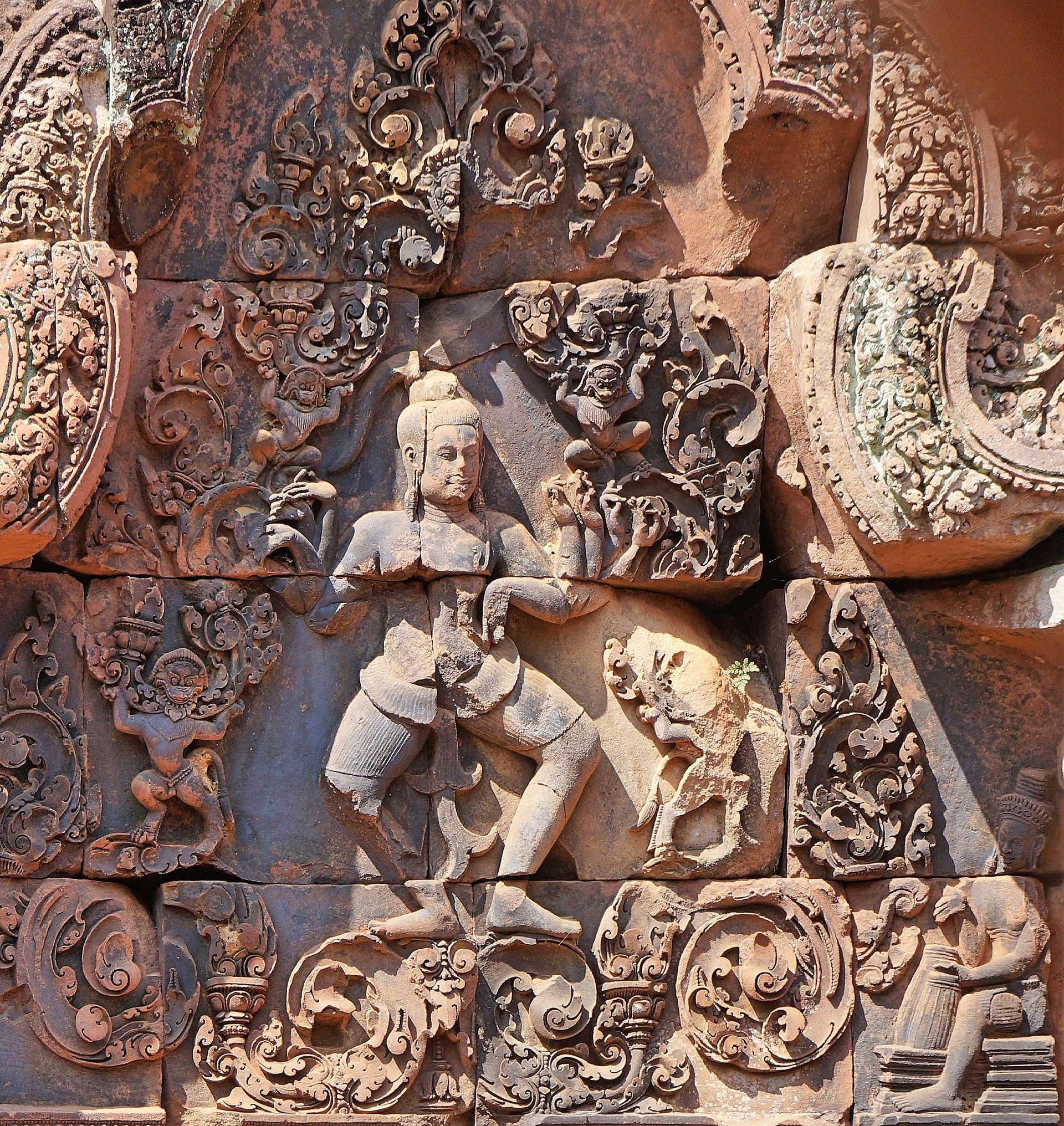
Banteay Srei is widely regarded as the jewel of Khmer art — the temple with the finest and most intricate carving anywhere in the Angkor region. It was consecrated in 967 AD and, unusually, was built not by a king but by Yajnavaraha, a Brahmin scholar and counsellor to King Rajendravarman II. Its original name was Tribhuvanamahesvara, "great lord of the threefold world", after the Shaivite linga enshrined in its central tower, and it stood at the heart of a small town called Isvarapura. The modern Khmer name, Banteay Srei — "Citadel of Women" — is usually taken to refer to the delicacy of the carving and the temple's small, human scale.
Built from a fine-grained pink-red sandstone that takes detail like almost no other stone at Angkor, the temple is covered in astonishingly deep, crisp relief work considered the finest examples of classical Khmer art. Its pediments and lintels are the highlight: elaborate scenes from Hindu mythology framed by dense floral scrollwork and flanked by carved guardians and devatas. Among the most celebrated are the demon-king Ravana shaking Mount Kailasa, the love-god Kama firing his arrow at Shiva, the burning of the Khandava Forest, and episodes from the Ramayana. Because the temple is small and low, visitors can study these masterpieces close up in a way that is impossible at the towering state temples.
Banteay Srei was cleared by French archaeologists in 1914, and in 1923 the young André Malraux was arrested for prising several carved blocks from it — a scandal that drew international attention to Angkor and later fed his novel "The Royal Way". Restoration began in 1931 under Henri Marchal, who chose Banteay Srei for the first successful use of anastylosis at Angkor — rebuilding the monument from its own original stones, a method borrowed from Dutch work in Java and afterwards applied across the park. The temple lies about 25 km northeast of the main Angkor group, so it takes a dedicated half-day; the pink stone glows most warmly in early morning and late-afternoon light, and it pairs well with the river carvings of Kbal Spean and the Cambodia Landmine Museum nearby.
Highlights
- ✦ Pink sandstone carvings (finest in Angkor)
- ✦ Scenes from the Ramayana and Mahabharata
- ✦ Intricate devata figures
- ✦ Pediment showing Ravana shaking Mount Kailasa
- ✦ Butterfly Centre nearby
- ✦ Cambodia Landmine Museum nearby
Best Time to Visit
Early morning (opens 7:30 AM) or late afternoon for golden light on pink stone
Visitor Tips
- 💡 Located 25 km from Angkor — plan 45 min each way
- 💡 Combine with Banteay Samré and Kbal Spean on the same day
- 💡 Bring binoculars to appreciate the intricate upper carvings
- 💡 The Cambodian Landmine Museum is only 7 km away
Nearby Temples
13.5986°N, 103.9630°E
Get Cambodia Travel Updates
Visa changes, travel tips, and destination guides delivered to your inbox.
No spam, unsubscribe anytime. We respect your privacy.