🛕 Angkor Wat
អង្គរវត្ត
Province
Siem Reap
Era
Classical Angkorian
Difficulty
🟢 Easy
Crowds
🏟️ Very High
Key Facts
Built: 12th century (1113–1150)
Built by: King Suryavarman II
Religion: Hindu-Buddhist
Entry Fee: Angkor Pass: $37/day, $62/3-day, $72/7-day
Time Needed: 3–5 hours for thorough visit
UNESCO: ✅ World Heritage Site
The world's largest religious monument — a 162.6-hectare temple complex and Cambodia's national symbol, depicted on the flag.
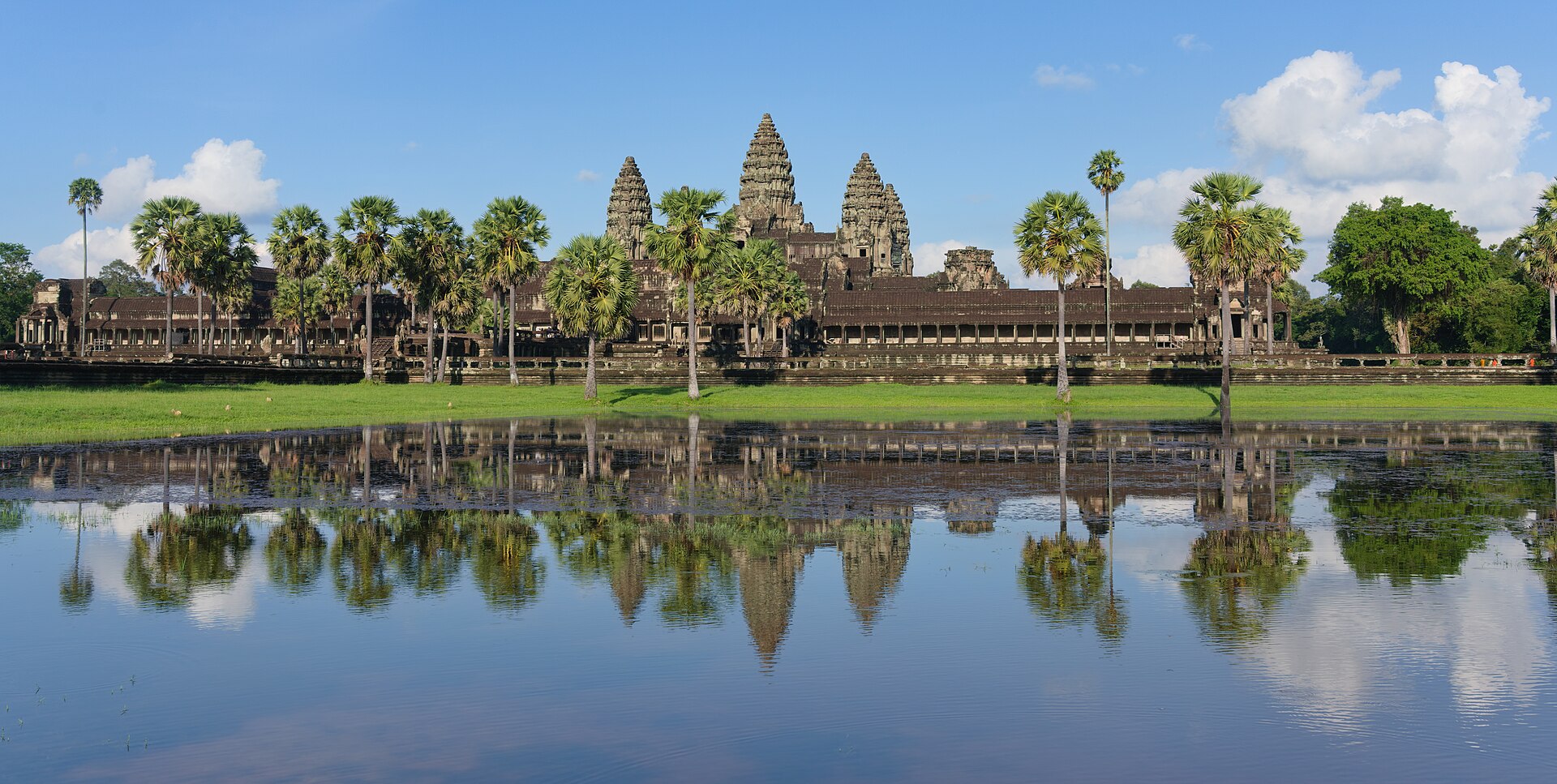
Angkor Wat is the crown jewel of Khmer architecture and the largest religious monument ever built, covering some 162 hectares within its rectangular moat. It was constructed in the first half of the 12th century (roughly 1113–1150) by King Suryavarman II as a state temple and, most scholars believe, his intended mausoleum — dedicated to the Hindu god Vishnu rather than to Shiva, who had been favoured by earlier Khmer kings.
The temple is a vast architectural metaphor for the Hindu cosmos. Its five lotus-bud towers arranged in a quincunx represent the peaks of Mount Meru, home of the gods; the concentric galleries stand for the surrounding mountain ranges; and the broad moat — about 190 metres wide and some 5 kilometres in perimeter — evokes the cosmic ocean. Unusually for a major Khmer temple, Angkor Wat faces west, the direction associated with Vishnu and with death, which is one of the main reasons it is thought to have served a funerary purpose.
Its most celebrated feature is the bas-relief gallery that runs for nearly 800 metres around the third enclosure. These carvings depict the Churning of the Sea of Milk, the great battles of the Mahabharata (Kurukshetra) and Ramayana (Lanka), the 37 heavens and 32 hells of Hindu belief, and a historical procession of Suryavarman II himself. More than 1,800 devata and apsara (celestial maidens) are carved across the walls, each with distinct features, jewellery and hairstyles.
Unlike many Angkor temples, Angkor Wat was never fully abandoned; it gradually became a Theravada Buddhist site from around the late 13th century and remains an active place of worship. It re-entered wider Western awareness after the French naturalist Henri Mouhot publicised it in the 1860s, and it is so central to Khmer identity that it appears on Cambodia's national flag — the only building to feature on any national flag. Angkor was inscribed as a UNESCO World Heritage Site in 1992, and conservation today is coordinated by the APSARA National Authority with international teams.
For visitors, sunrise behind the towers mirrored in the northern reflecting pond is one of Southeast Asia's iconic sights; arrive well before dawn in high season. Allow two to three hours to explore, enter with a valid Angkor Pass, and dress respectfully with shoulders and knees covered to climb to the upper (Bakan) level.
Highlights
- ✦ Sunrise over the five towers
- ✦ Gallery of bas-reliefs (800m long)
- ✦ 1,800+ unique devata carvings
- ✦ Churning of the Ocean of Milk scene
- ✦ Third level panoramic views
- ✦ Reflecting pool photo spot
Best Time to Visit
Arrive before 5:30 AM for sunrise. Afternoon (2-5 PM) has fewer crowds.
Visitor Tips
- 💡 Buy your pass the afternoon before at the ticket office for a free sunset visit
- 💡 Wear clothes covering knees and shoulders for the upper level
- 💡 Hire a licensed guide ($25-35) for historical context
- 💡 The south gallery bas-reliefs are the most impressive
Nearby Temples
13.4125°N, 103.8670°E
Get Cambodia Travel Updates
Visa changes, travel tips, and destination guides delivered to your inbox.
No spam, unsubscribe anytime. We respect your privacy.