🛕 Ta Prohm
តាព្រហ្ម
Also known as: Rajavihara, Tomb Raider Temple
Province
Siem Reap
Era
Late Angkorian
Difficulty
🟢 Easy
Crowds
🏟️ Very High
Key Facts
Built: 1186
Built by: King Jayavarman VII
Religion: Buddhist
Entry Fee: Angkor Pass
Time Needed: 1–2 hours
UNESCO: ✅ World Heritage Site
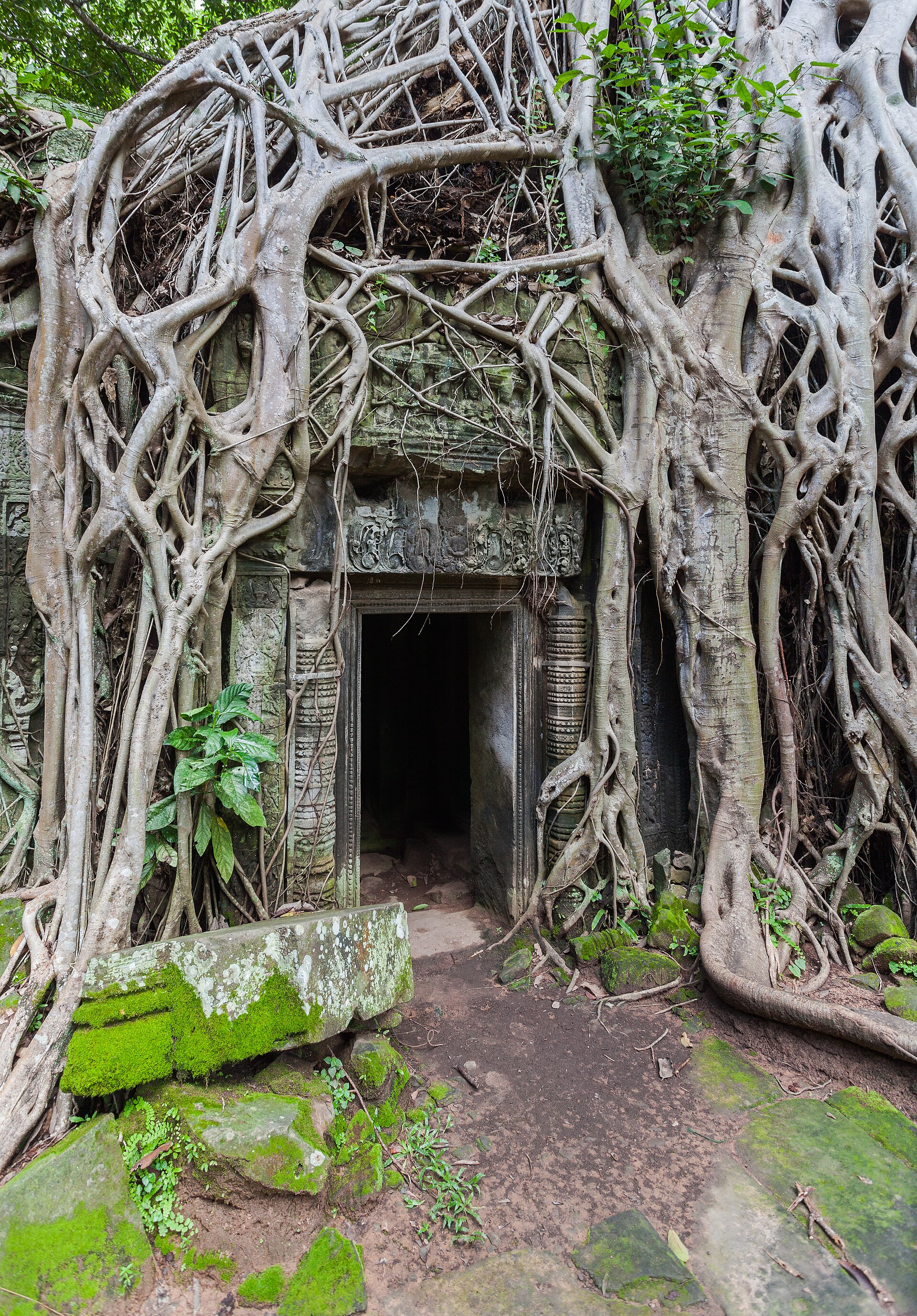
The atmospheric "Tomb Raider temple" where massive silk-cotton and strangler fig trees dramatically engulf ancient stone walls.
Ta Prohm is one of the most photogenic and atmospheric temples at Angkor, famous for being deliberately left in a state of semi-ruin with great trees growing through and over the ancient stones. Built in the late 12th century by Jayavarman VII and originally named Rajavihara ("the royal monastery"), it was dedicated to the king's mother in the form of Prajnaparamita, the Buddhist perfection of wisdom.
Far more than a temple, Ta Prohm was a wealthy Buddhist monastery and centre of learning. Its Sanskrit foundation stele records an astonishing establishment: some 12,640 people served the temple directly, with tens of thousands more in surrounding villages supporting it, including 18 high priests and over 600 dancers. The inscription even lists its treasures — gold, pearls and silks — evoking the vanished splendour of the Khmer golden age.
When Angkor was cleared and restored in the 20th century, conservators chose to leave Ta Prohm largely as it was found, as a memorial to the power of nature over human works. The result is its signature sight: enormous silk-cotton trees (Tetrameles nudiflora) and strangler figs whose roots pour over and prise apart the galleries. The temple reached global fame as a filming location for Lara Croft: Tomb Raider (2001).
Because the ruin is fragile, teams (led in recent decades by the Archaeological Survey of India) have carried out careful stabilisation, and some famous trees have had to be supported or lost to storms. It is one of Angkor's busiest temples — visit early or late to photograph the celebrated tree-and-stone tableaux without the crowds.
Background
Ta Prohm was built in the Bayon style largely in the late 12th and early 13th centuries. Jayavarman VII founded it as a Mahayana Buddhist monastery and centre of learning dedicated to his mother, and the foundation stele gives a date of 1186. Its main image, representing Prajnaparamita, the personification of wisdom, was modelled on the king's mother. The stele records more than 12,500 people at the site, including 18 high priests and 615 dancers, with a further 80,000 in surrounding villages providing services and supplies. After the fall of the Khmer Empire the temple was abandoned, and conservators later chose to leave it largely as found. The trees growing out of the ruins are perhaps its most distinctive feature, and it has been on the UNESCO World Heritage List since 1992.
Adapted from the Wikipedia article “Ta Prohm” (revision 1369410912, retrieved 19 October 2026), licensed under CC BY-SA 4.0; text condensed and edited.
Print references cited by the Wikipedia article:
- Coedès, George. "La stèle de Ta-Prohm," in Bulletin de l'École française d'Extrême-Orient, Vol.6, No.1-2 (1906), pp. 44–86 (gives the original text of the foundational stele; listed under Further reading)
- Freeman, Michael and Jacques, Claude. Ancient Angkor. River Books, 1999. ISBN 0-8348-0426-3 (listed under Further reading)
Highlights
- ✦ Giant tree roots growing over walls
- ✦ Tomb Raider filming location
- ✦ "Crocodile Tree" root formation
- ✦ Hall of Dancers apsara gallery
- ✦ Atmospheric narrow corridors
- ✦ Photo-op with tree-root doorways
Best Time to Visit
Early morning (7-8 AM) or late afternoon to avoid peak crowds
Visitor Tips
- 💡 Follow the marked route through the temple
- 💡 The "dinosaur" carving on the east side is a popular debate point
- 💡 Combine with Banteay Kdei and Srah Srang nearby
- 💡 Rainy season (June-Oct) makes the green moss extra vivid
Nearby Temples
13.4351°N, 103.8891°E
Get Cambodia Travel Updates
Visa changes, travel tips, and destination guides delivered to your inbox.
No spam, unsubscribe anytime. We respect your privacy.